's-Hertogenbosch (1)
Aalborg (1)
Aalst (1)
Aarhus (1)
Affligem (1)
Aichi (1)
Albissola (1)
Alcacer do Sal (3)
Alessandria (1)
Algeciras (1)
Alicante (1)
Almere (4)
Antwerp (4)
Antwerp (1)
Amsterdam (22)
Arnhem (1)
Úbeda (1)
Atlanta (2)
Atsugi (0)
Águilas (1)
Evora (1)
Ballerup (1)
Barcelona (53)
Basel (7)
Bègles (1)
Belgrado (1)
Benidorm (1)
Berlin (10)
Bilbao (7)
Bogota (2)
Boston (5)
Boulogne Billancourt (2)
Brasilia (2)
Brasilia (0)
Bremen (1)
Brussels (8)
Bubikon (1)
Buenos Aires (1)
Bordeaux (19)
Cambridge (3)
Cádiz (1)
Córdoba (2)
Cerklje (1)
Ceuta (3)
Chengdu (1)
Chicago (18)
Cape Town (0)
Coimbra (1)
Colmenar Viejo (1)
Como (1)
Copenhagen (43)
Coslada (1)
Creus (3)
Cuevas del Almanzora (1)
Culemborg (1)
Cully (1)
Dallas (1)
Denver (2)
Derendingen (0)
Dessau (2)
Dijon (2)
Donostia-San Sebastián (1)
Dubai (3)
Dulliken (1)
Dunkirk (1)
Durango (1)
Eberswalde (1)
Eindhoven (3)
Elmswell (1)
Istambul (1)
Fürth (0)
Philadelphia (2)
Florence (3)
Formoso do Araguaia Tocantins (1)
Fredericia (1)
Fribourg (1)
Gaasbeek (1)
Ghent (11)
Gardouch (0)
Girona (1)
Gonesse (1)
Gouda (1)
Graz (3)
Greensboro (2)
Grenoble (2)
Groningen (4)
Guangzhou (2)
Haarlem (1)
Hamamatsu (6)
Hamburg (4)
Hanoi (1)
Hanover (1)
Helsinki (4)
Holbaek (1)
Hoofddorp (1)
Houston (0)
Houston (0)
IBIZA (0)
(0)
Innsbruck (2)
Inujima (5)
Jersey City (1)
Køge (0)
Kilchberg (1)
Kyoto (4)
Knokke-Heist (1)
Kobe (4)
Kolding (1)
Kuwait (1)
Havana (5)
Landquart (1)
Las Palmas (1)
Le Havre (1)
Lille (2)
Lima (2)
Lincoln (1)
Lisbon (4)
Ljubljana (10)
Llantwit Major (1)
Lleida (2)
Lohja (1)
London (62)
Longyearbyen (2)
Los Angeles (3)
Los Palacios y Villafranca (1)
Louisville (3)
Lousada (1)
Louviers (1)
Leuven (2)
Lustenau (1)
Lyon (3)
Maasbracht (1)
Madrid (54)
Mafikeng (2)
Magdeburg (1)
Mechelen (1)
MAJORCA (0)
MALMOE (0)
Malpica (1)
Maribor (2)
Marseilles (2)
Málaga (1)
Meiningen (1)
Melbourne (4)
Melle (1)
Merchtem (1)
Mexico DF (4)
Miami (3)
Mieres (2)
Milan (14)
Millwaukee (2)
Milwaukee (0)
Mongat (0)
Monte Carasso (1)
Montjoire (0)
Montreal (1)
Mortsel (1)
Moscow (8)
Munich (11)
Murcia (1)
Nagoya (1)
Nanjing (1)
Nanterre (2)
Nantes (4)
Naoshima (3)
Newcastle-upon-Tyne (1)
Nieuwegein (1)
Niterói (1)
Noormarkku (1)
Norway (1)
New York (31)
New Hampshire (0)
Nuremberg (1)
Oberentfelden (1)
Okayama (3)
Porto (2)
Oslo (5)
Oudenaarde (2)
Pantin (2)
Paris (69)
Parma (1)
Beijing (4)
Phoenix (2)
Poissy (1)
Prague (2)
Presov (1)
Providence (3)
Puteaux (2)
Rabat (0)
Ravenna (1)
Rotterdam (24)
Reggio Emilia (1)
Reus (3)
Riga (1)
Riihitie (1)
Rodovre (1)
Rome (3)
Romainville (0)
Runcorn (1)
Saint Etienne (2)
Salzburg (1)
Samobor (1)
San Francisco (7)
San Vicente del Raspeig (1)
Sant Just Desvern (0)
Sant Just Desvern (1)
Santander (1)
Santiago de Compostela (1)
Sao Paulo (3)
sànt feliu de Llobregat (0)
Scottsdale (1)
Seattle (3)
Seoul (5)
Semmerzake (1)
Sevilla (4)
Sheffield (2)
Shenzhen (2)
Singapore (4)
Sittard (1)
Spremberg (2)
Suffolk (1)
Suresnes (1)
Sydney (4)
Taichung (1)
Taipei (2)
Takamatsu (4)
Tallinn (1)
Tartu (1)
Tel Aviv (4)
Tempe (1)
Tenri (1)
Teshima (0)
Tokyo (19)
Toledo (1)
Toronto (7)
Tromso (1)
Trondheim (2)
Troyes (2)
Turin (2)
Turku (1)
Uithoorn (1)
Utrecht (2)
Vancouver (1)
Venice (1)
Vicenza (1)
Victoria (1)
Vienna (6)
Vila do Conde (1)
Vila Nova de Gaia (1)
Vila-Seca (1)
Viladecans (2)
Vitoria-Gasteiz (4)
Wallisellen (1)
Walsall (0)
Washington (1)
Winterthur (3)
Yokohama (0)
Ypenburg (2)
Zaanstad (1)
Zaragoza (7)
Zurich (24)
Zuiderplein (0)
Zwolle (3)


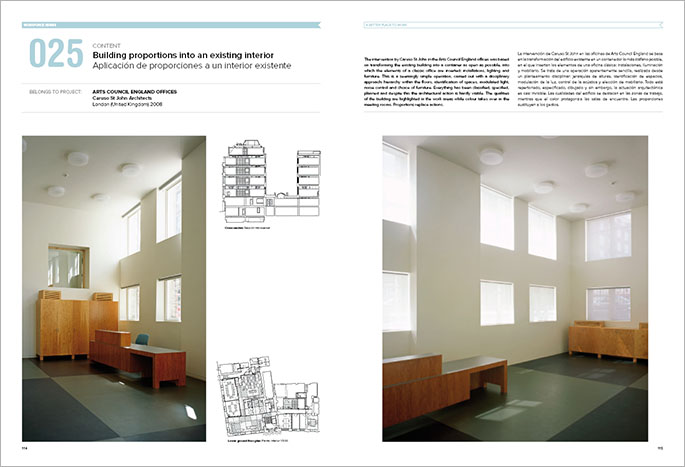
The intervention by Caruso St John in the Arts Council England offices was based on transforming the existing building into a container as open as possible, into which the elements of a classic office are inserted: installations, lighting and furniture. This is a seemingly simple operation, carried out with a disciplinary approach: hierarchy within the floors, identification of spaces, modulated light, noise control and choice of furniture. Everything has been classified, specified, planned a.
(more...)
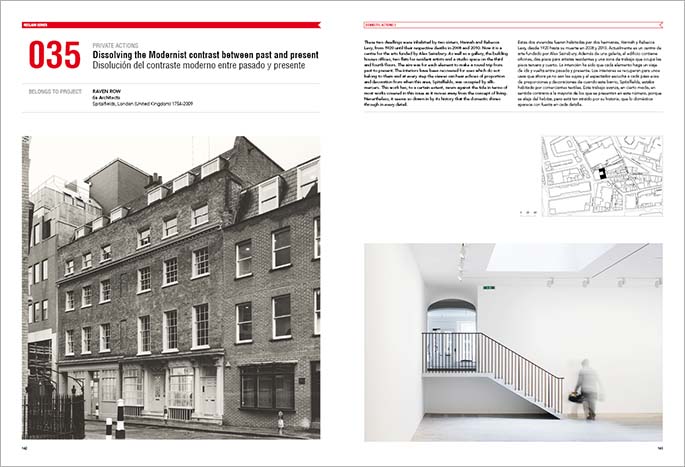
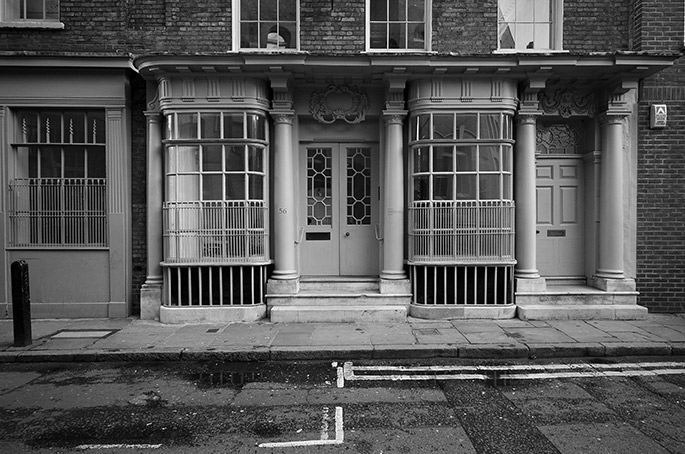
These two dwellings were inhabited by two sisters, Hannah and Rebecca Levy, from 1920 until their respective deaths in 2008 and 2010. Now it is a centre for the arts funded by Alex Sainsbury. As well as a gallery, the building houses offices, two flats for resident artists and a studio space on the third and fourth floors. The aim was for each element to make a round trip from past to present. The interiors have been recovered for uses which do not belong to them and at every step the viewer .
(more...)
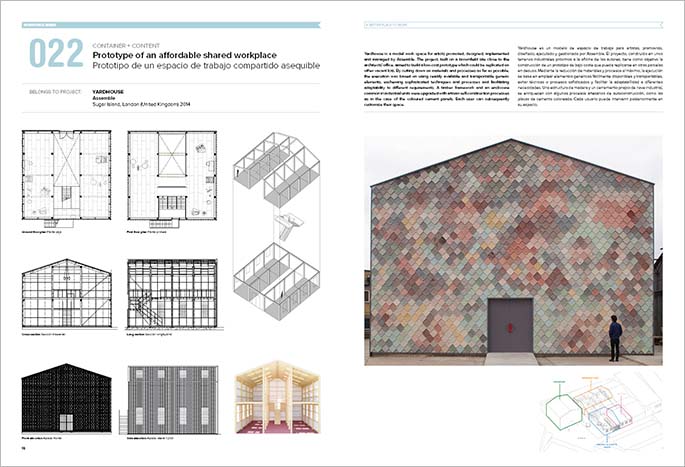
Yardhouse is a model work space for artists promoted, designed, implemented and managed by Assemble. The project, built on a brownfield site close to the architects’ office, aimed to build a low-cost prototype which could be replicated on other vacant lots. By cutting down on materials and processes as far as possible, the execution was based on using readily available and transportable generic elements, eschewing sophisticated techniques and processes and facilitating adaptability to d.
(more...)
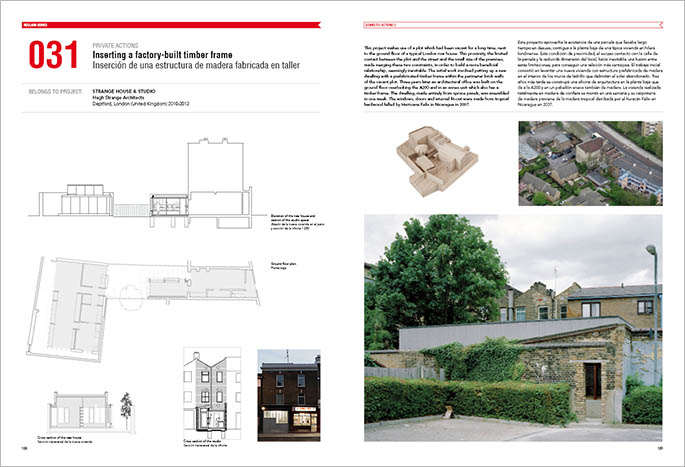
This project makes use of a plot which had been vacant for a long time, next to the ground floor of a typical London row house. This proximity, the limited contact between the plot and the street and the small size of the premises, made merging these two constraints, in order to build a more beneficial relationship, seemingly inevitable. The initial work involved putting up a new dwelling with a prefabricated timber frame within the perimeter brick walls of the vacant plot.
.
(more...)
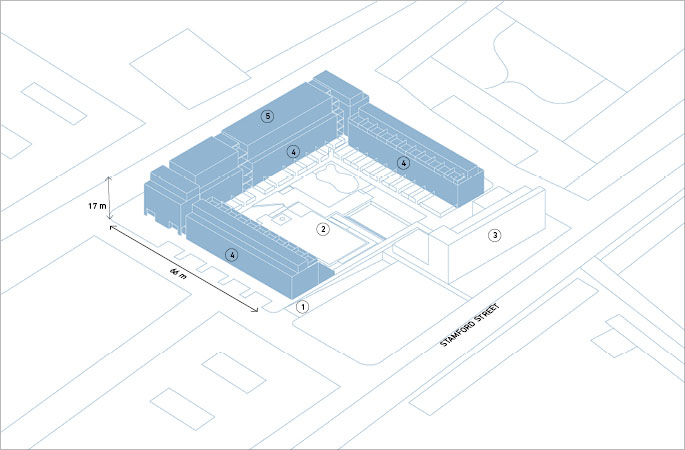
1. Access to the public car park 2. Communal garden and playground 3. Community facilities building 4. Townhouses 5. Duplex penthouses
The dwellings are arranged around an open courtyard, a hollow square, which allows communal space to be maximised in the form of a large landscaped garden with play area, bounded on three sides by residential accommodation and, on the fourth side, by a community facilities building.
Iroko housing HAWORTH TOMPKINS London (United Kingdom) 2002
Plot area: 7,672 m2
Floor Area: 6,390 m2
Coverage: 0.31
Floor Area Ratio: 0.83
Dwellings: 59
Parking places: 287
Other uses: fac.
(more...)
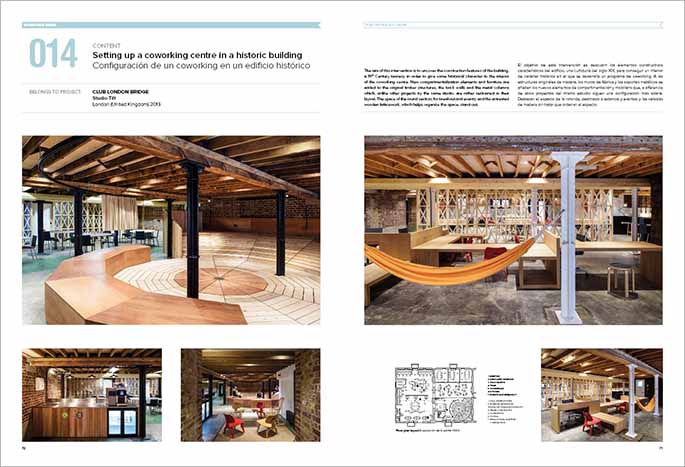
The aim of this intervention is to uncover the construction features of the building, a 19th Century tannery, in order to give some historical character to the interior of the coworking centre. New compartmentalization elements and furniture are added to the original timber structures, the brick walls and the metal columns which, unlike other projects by the same studio, are rather restrained in their layout. The space of the round section, for breakout and events, and the untreated wooden la.
(more...)
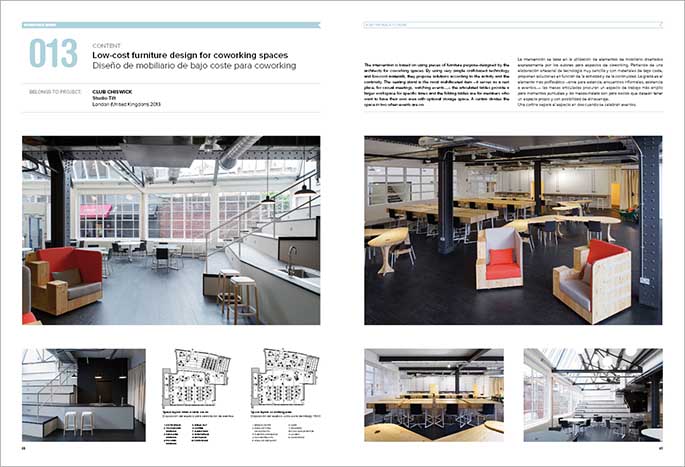
The intervention is based on using pieces of furniture purpose-designed by the architects for coworking spaces. By using very simple craft-based technology and low-cost materials, they propose solutions according to the activity and the continuity.
PROJECT PUBLISHED IN:
&nbs.
(more...)







 I've read and agree to