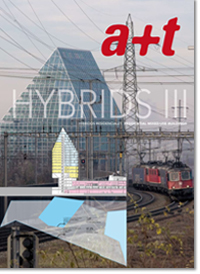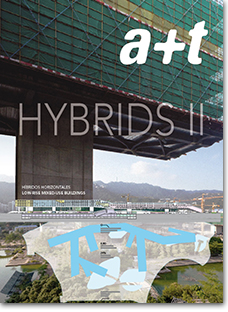
a+t 32.
ISSN 1132-6409
2008
Bilingual: English/Español 160 Pages
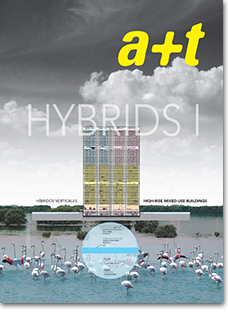
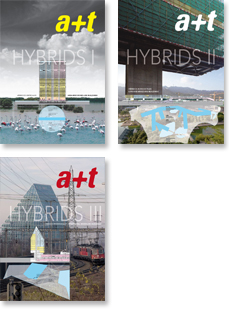
The analysis of hybrid buildings, started in the first issue of the Hybrids series with high-rise uses, now continues with the development of horizontal projects.
Massive land occupation, imposition on the weft, topographical modification of surroundings and the introduction of mobility in programmes are the most common conditions.
Nevertheless, unlike vertical hybrids, horizontal hybrids are more able to disguise themselves in the landscape, even separating into quasi-independent elements. They are buildings that renounce iconic character in favour of invasive character.

Extract from the article written by Javier Mozas: `Mixed uses. A historial overview', included in a+t 32. Hybrids II. Low-rise Mixed-used Buildings.
Richard
Sennett wrote that a cosmopolitan is someone who moves comfortably in
diversity, who is at home in situations which are not connected or parallel to
what is familiar to him. Just like hybrid buildings. They are
cosmopolitan buildings, placed in fragmented forms that do not correspond, in volumes based on
remnants of previous mixed typologies, where its body fits with more or less
fortune. They produce a new being with a unifying personality. The
following paragraphs define the characteristics and personality of hybrids.
They are, consciously, absolute maxims, grouped by themes that point out the
categorical and defining, so that their personality traits are as noticeable as
possible.
Personality
The
personality of the hybrid is a celebration of complexity, diversity and
variety of programmes. It is the crucible for a mixture of different interdependent
activities.
The hybrid building is a self-tribute to the individual creation of the architect. Each hybrid is a unique creation, without previous models. The very building comes from an innovative idea, which is resolved against the established combination of usual programmes and bases its reason for existence on the novelty of the approach and the unexpected mixing of functions.
The hybrid is an opportunist building, which takes advantages of its multiple skills. The hybrid building looks for unexpected, unpredictable, intimate relationships, encourages coexistence and is conscious that unprogrammed situations are the keys to its own future.
The hybrid shows its many facets and its own personality. As it depends on the individual nature of its creation process, it can take on multiple representations, even apparently contradictory representations, urban landmark, sculpture, landscape or anonymous volume.
The landmark hybrid is not subject to indifference. It is meant to impact the observer. It does not go unnoticed, but publicly manifests its skills, its extroverted character and its attractive points. The hybrid building as a milestone, is an actor in a starring role on the urban stage.
The anonymous hybrid, on the contrary, requires each part of the programme to lose its originality. If it holds a public programme, what is collective will have to dissolve its character and conform to being another simple secondary actor on the daily stage of the city.
Sociability
The ideal
hybrid feeds on the meeting of the private and public spheres. The intimacy of private life and
the sociability of public life find anchors of development in the hybrid
building.
The permeability of the hybrid makes it accessible from the city and the private use of its services extends its timetable to 24 hours a day. This means that activity is constant and is not controlled by private or public rhythms. Another use category is created, a full-time building.
Form
The
Modernism insistence upon correspondence between form and function of a
building no longer works. The form-function relationship in a hybrid can be
explicit or implicit. The first case leans towards fragmentation, the second
towards integration.
A generic hybrid is a building-container that attempts a habitat undifferentiated from the diversity of functions that are grouped inside.
The hybrid building will always fight against those segregationist morphologies that allow the escape from some use and looks to unite, inside their area of influence, all of the activities that can provide life to it.
Typology
The
primitive hybrid, or proto-hybrid, has not reached the highest point of
integration among its functions and is seen as a set of typologies that have
not yet been fused. One cannot classify hybrid buildings by typologies, because
in the very essence of the hybrid exists the escape from categories.
The hybrid is the consequence of a rebound with tradition, a two-fingered salute to typology.
Processes
The
mixture of uses is a part of the general processes of the hybridation. Property
and land development can also be hybrid, by means of a combination of public and
private developing. Structure can be hybrid, based on mixed solutions of
concrete and steel. Construction can be hybrid with dry assembled elements with
wet joints, or the same can be done with prefabrication and traditional
assembly methods. Management can be hybrid, with individual and community
multi-properties.
Programmes
The mixing of uses in a hybrid building
generates a potential which is transferred, as in a system of connected vessels, to those weaker activities so that
all involved are benefited. Hybrid buildings are organisms with multiple
interconnected programmes, prepared to house both planned activities as well as
those unplanned activities in a city.
Density
Dense
environments with land use limitations are a good field of cultivation for
hybrid situations. The hybrid scheme proposes intense environments
of cross fertilisation, which mix known genotypes and create genetic allies to improve living
conditions and revitalise their surrounding environments.
Scale
Hybrids
have the character of super-buildings, super-blocks, megastructures or of
Building-as-a-City. As some of the projects included in this issue suggest,
they are “urban monsters of a new and generous breed.”
Hybrids are associated with a certain form of grandeur, splendor and gigantism, because mixing implies size and superposition demands height. The taking over of the surface to extend the programme takes up land. It also needs a creative impulse and economic confidence, since it produces new situations inadequate for times of indecision.
The scale of a hybrid and its relationship with the environment is measured by the juxtaposition of programmatic sections. In vertical hybrids, functions are joined by superposition and in horizontal hybrids, by on-floor additions.
City
Because
of its scale, urban composition strategies can be added to a
hybrid. The
definition of a hybrid includes perspective, grid insertion, dialogue with
other urban landmarks and interrelationships with the surrounding public space.
Occasionally, what is hybrid is the urban plan, made up of a series of mono-functional buildings gathered around a common stage, which represents most of the citizen theatrical world.
The hybrid
goes beyond the domain of architecture and enters the realm of urban planning.
Extract from the article written by Javier Mozas: `Mixed uses. A historial overview', included in a+t 32. Hybrids II. Low-rise Mixed-used Buildings
Extract from the article published by David Franco and Pablo Martínez Capdevila in a+t 32. Hybrids II. Low-rise Mixed-use Buildings
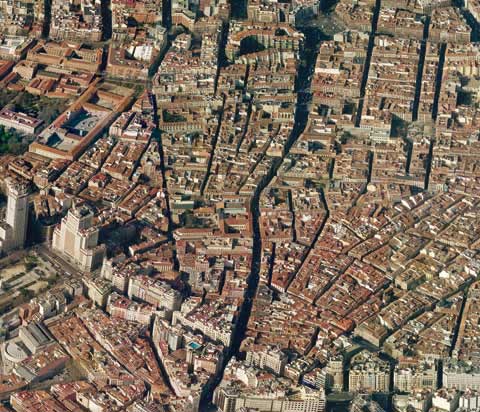
We wish to propose an extended notion of the concept of urban hybridization, an idea that would go beyond the mere mixing of different uses and emerge as a theoretical and proactive answer to the growth problems that European and, more specifically Spanish cities, are facing. The Triptic project, developed by the Wunderkammer group, which we are part of, within the Alter Polis exhibition at the Matadero of Madrid, explores the possibilities of two types of apparently contradictory operations designed for the centre of Madrid.
Unlike urban growth models used over the last few decades, based on the extensive occupation of city limits, colonising vacant, natural or agricultural land, the recent paradigm of sustainability once again moves the focus of interest towards existing urban fabrics. The recycling and transformation of areas already consolidated has been revealed to be the most efficient expansion method in relation to consumption of resources. It thus seems convenient to rethink methods of action inside urban cores, especially in the areas that accumulate more potential attraction to residents as the historic centres.
The triptic Project first, it explores the increase in density by means of a radical tridimensionalisation process and, secondly, an increase in porosity, in the quantity of public space in direct contact with the built-up environment. What we refer to is thus a commitment to porous density, to a culture of urban congestion which, unlike that which the market produces spontaneously, takes seriously the issue of space instead of trivializing it.
1.- Choose version
- Printed version: 25.00 €
2.- Destination
Choose your country to calculate the shipping costs


Check out


I've read and agree to